
You don’t need more time to teach with compassion. Here’s how UK secondary teachers can apply trauma-informed principles in real classrooms — without burning out.
Let’s Get Real: Teaching Is Emotional Labour
You’re teaching through underfunding, over-testing, behaviour crises, and mounting pressure to meet “standards” that don’t reflect reality. And through it all, you’re still expected to care. Deeply.
The system rarely leaves room for it — but you still show up with compassion.
This post isn’t another guilt trip. It’s a roadmap for teachers who care, but are exhausted. It’s about what’s possible — even when time, energy, and support are scarce.
Because trauma-informed teaching isn’t about doing more. It’s about doing differently.
What Do We Mean By “Trauma-Informed”?
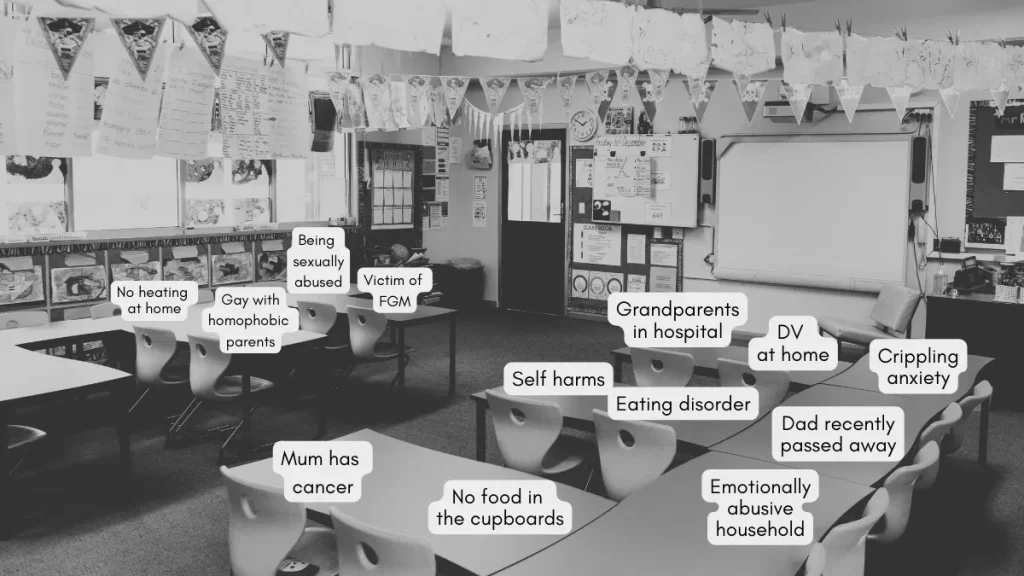
Trauma-informed education recognises that many young people carry invisible pain. Whether it’s caused by abuse, neglect, loss, racism, poverty, or chronic stress — trauma shows up in schools.
Not just in behaviour. But in shutdowns, perfectionism, avoidance, aggression, withdrawal, or hypervigilance.
Being trauma-informed means we:
- Assume trauma is present, even if we can’t see it
- Respond with care, not control
- Prioritise safety, trust, and agency
And we apply that same lens to ourselves as educators.
“But I Don’t Have Time for This…”
You don’t need to become a counsellor. You don’t need hours of planning time or a new behaviour policy.
What you need is a shift in approach.
Here’s how trauma-informed teaching can look — in small, sustainable ways that protect both you and your learners.
1. Build Safety Through Predictability
Young people who’ve experienced trauma crave stability — even when they resist it.
Create safety by:
- Keeping routines consistent
- Letting students know what’s coming next
- Offering visual timetables or “lesson breakdowns”
- Giving advance notice of transitions or changes
When students know what to expect, their nervous systems can rest.
2. Regulate Before You Educate
A dysregulated brain can’t learn. If a student is escalated, withdrawn, or anxious, no amount of explanation will land.
Trauma-informed teachers know that co-regulation is key.
Start with:
- Calm tones and body language
- Short instructions
- Options, not ultimatums
And most importantly, regulate yourself first.
You don’t need to respond perfectly. You just need to stay grounded enough not to escalate with them.
3. Offer Choices (Even Tiny Ones)
Trauma robs young people of control. Offering choices — even small ones — helps restore a sense of agency.
Instead of:
“Get started now.”
Try:
“Do you want to start with the first question or the second?”
Instead of:
“You have to stay in your seat.”
Try:
“Would you rather work at your desk or the back table?”
It’s not about being soft. It’s about helping students feel safe enough to engage.
4. Repair, Don’t Punish
When students “act out,” the instinct is often to isolate or sanction.
But trauma-informed practice asks: what does this student need in order to feel safe again, in themselves, and in the classroom?
That’s where repair comes in:
- Quiet conversations after lessons
- Restorative circles (even informal ones)
- Acknowledging your own role, if relevant
- Helping students name what happened, how it felt, and what they might do differently
This isn’t about excusing harm. It’s about building the skills to respond to it.
5. Protect Your Own Humanity
You can’t hold space for others if no one’s holding space for you.
Teachers need trauma-informed workplaces too:
- Boundaries around contact time
- Support after violent incidents
- Supervision or reflective spaces
- Compassionate leadership
If you’re not getting that — name it. Document it. Ask for it. And in the meantime, build what you can: peer check-ins, debriefs, micro-moments of grounding.
Being a trauma-informed teacher doesn’t mean being endlessly self-sacrificial. It means modelling what healing can look like — for your students and yourself.
Final Thoughts: You Don’t Need More. You Just Need Permission
You’re already doing more than anyone realises. And you don’t need a new framework to start this work.
You just need permission to pause.
To prioritise relationships over rigid routines.
To see behaviour as communication, not defiance.
To bring your full humanity into the room — and allow your students to do the same.
Because when safety comes first, learning follows.
Want more tools, real-talk guidance, and system-shaking support?
Join the Revolutionary Education mailing list for trauma-informed strategies, restorative resources, and a community that gets it.