
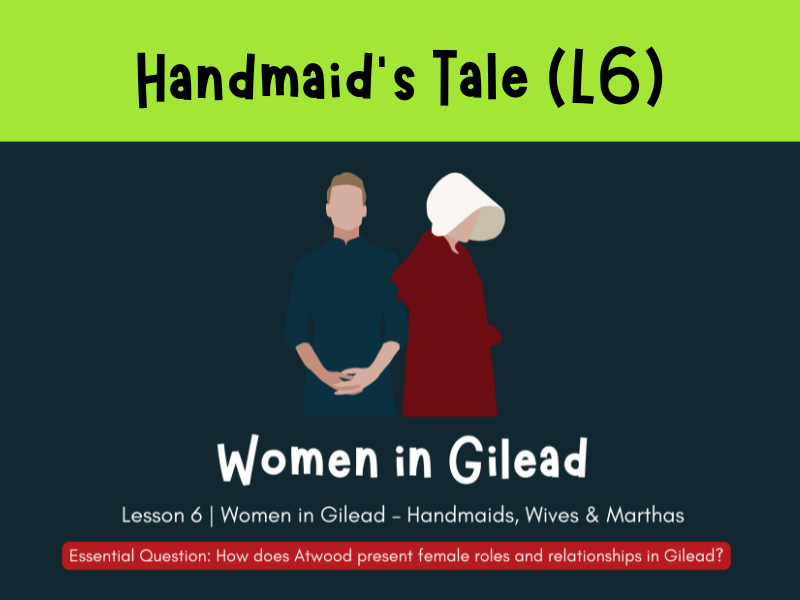
The Handmaid’s Tale – Lesson 6: Women in Gilead
In this lesson, students will explore the essential question: How does Atwood present female roles and relationships in Gilead? Through analysis of The Handmaid’s Tale, students will examine the societal roles of women—including Handmaids, Wives, and Marthas—and how these roles reinforce Gilead’s power structures. They will also consider how Atwood’s portrayal of women reflects both historical and contemporary gender dynamics, highlighting tensions, alliances, and power struggles between female characters.
Lesson Objectives:
- To be able to identify the key societal roles of women in Gilead and their purpose within the regime.
- To understand how Atwood presents female relationships, including rivalry, resentment, and solidarity.
- To be able to analyze the ways in which women experience oppression differently based on their status.
- To be able to compare Gilead’s gender hierarchy to real-world historical or literary examples.
Lesson Activities:
- Starter Task – Quick Discussion:
Students will explore the following questions:- What roles do women traditionally occupy in patriarchal societies?
- How might these roles be used to maintain power structures?
- Task 1: Understanding Women’s Roles
- Students are assigned one of the following groups: Handmaids, Wives, or Marthas.
- Using Chapters 11-13, they identify key characteristics, duties, and limitations of their assigned group.
- Groups present their findings, discussing how these roles enforce Gilead’s control.
- Task 2: Female Relationships & Oppression
- Close analysis of key interactions between Serena Joy, Offred, and Rita.
- Discussion of how power shifts within female relationships.
- Task 3: Comparative Analysis
- Students compare Handmaids, Wives, and Marthas to real-world historical or literary examples of gender oppression.
- Exit Task – Quick Reflection:
- Which female character in Gilead do you think has the most power, and why?
- Students write a short response in their workbooks or discuss in pairs before sharing key ideas.
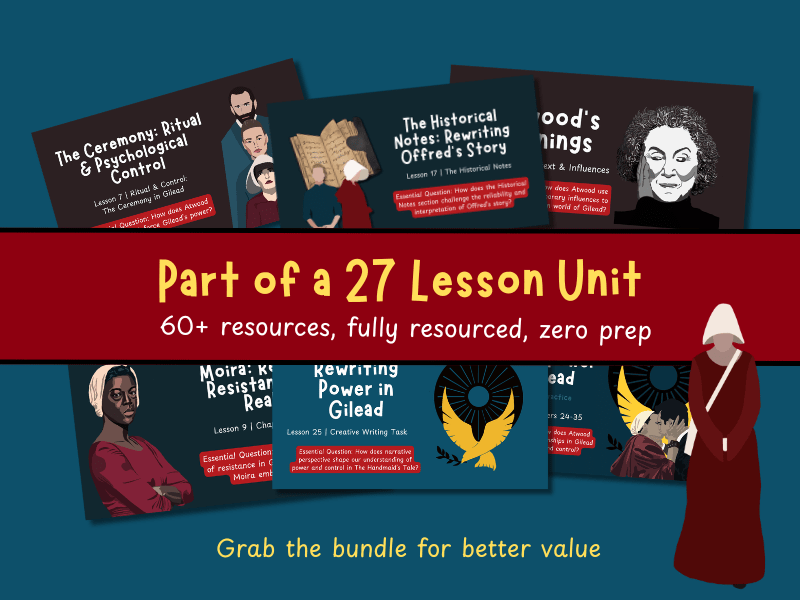
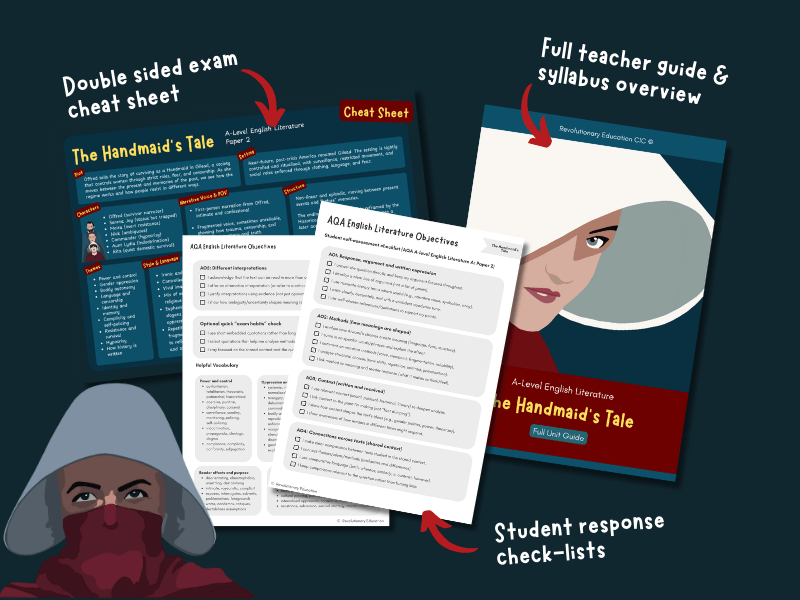
For the full unit pack and other resources in this unit, visit my TES shop—available on 8th March!
Copyright Notice: This resource is for personal classroom use only. Redistribution, resale, or uploading to shared platforms (including school drives and VLEs not for personal classroom use) is strictly prohibited. If you need additional licences, please purchase them separately. © 2024. Revolutionary Education. All rights reserved.



Reviews
There are no reviews yet.