

You find what looks like the perfect teaching resource online. The topic matches your child’s interests, the learning appears appropriate and, for once, you do not have to create everything yourself. Then you download it and discover a twelve-page lesson plan, three differentiated worksheets, a group discussion, a classroom display activity and instructions written for thirty children sitting behind desks.
Classroom resources can still be incredibly useful for home education. You just need to separate the valuable learning from the classroom systems wrapped around it.
Adapting a resource does not mean reproducing the whole lesson at home or persuading your child to complete every question on the page. It means identifying what the resource is trying to teach and finding a version of the activity that works for your child, your environment and your approach to home ed.
This guide will show you how to do that without creating hours of additional work.
Can you use classroom resources for home education?
Yes! Worksheets, lesson plans, presentations, workbooks and other school resources can all provide useful explanations, questions, activity ideas and subject knowledge. You do not need to reject something simply because it was originally made for a classroom.
However, a resource designed for school has been created within a particular context. It may assume that:
- One adult is teaching a large group.
- Every child needs to work on the same topic at the same time.
- The activity must fit inside a set lesson.
- Progress needs to be recorded in a particular form.
- Children are working within age-based year groups.
- Written work is the main way to demonstrate learning.
- Equipment, classmates or a large working space are available.
Most of those conditions do not apply at home. That is why a classroom resource should be treated as raw material rather than a set of instructions that must be followed exactly.
In England, parents are responsible for providing an efficient, suitable, full-time education appropriate to their child’s age, ability, aptitude and any special educational needs. The official guidance does not say that home educators must reproduce school lessons or use classroom-style resources. Education is compulsory, but school attendance is not. Laws and guidance differ across the four UK nations, so parents should consult the current guidance for where they live. You can read the Department for Education’s guidance for parents in England.
Begin with the purpose, not the worksheet
Before changing anything, ask: What is my child actually meant to learn here?
A worksheet may contain twenty questions, but completing twenty questions is not the learning objective. The purpose might be to:
- Recognise equivalent fractions.
- Use persuasive language.
- Understand the main stages of a life cycle.
- Interpret information from a graph.
- Compare two historical sources.
- Practise a spelling pattern.
Once you understand the purpose, you have much more freedom. Your child might demonstrate that understanding through conversation, practical work, drawing, construction, movement, photography, drama, audio recording or a short piece of writing.
For example, imagine you have downloaded a worksheet asking children to label the parts of a flower. If the aim is to identify and understand those parts, your child could instead dissect a real flower, photograph each part and add digital labels. The learning remains; only the method changes.
This distinction is particularly helpful if your child understands a subject well but finds handwriting, sustained attention or processing a crowded page difficult. The method used to record learning should not become an unnecessary barrier to showing what they know.
A simple five-step method for adapting classroom resources
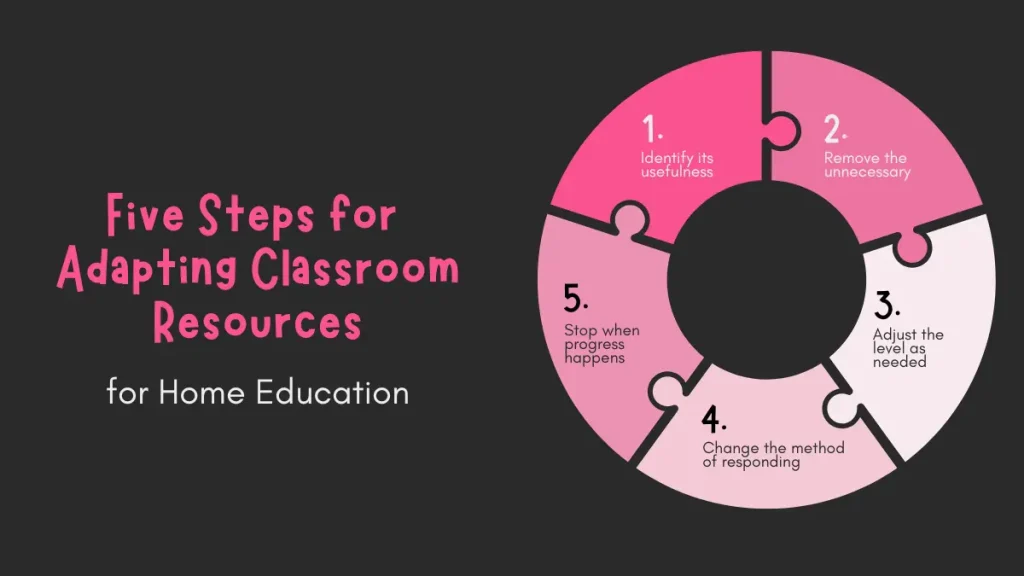
You do not need to redesign every resource from scratch. Work through these five steps and change only what needs changing.
1. Identify the useful core
Look through the resource and highlight the parts that contribute directly to the learning. This might include:
- A clear explanation
- A useful diagram
- A worked example
- A practical activity
- A set of thoughtful questions
- An interesting source, image or text
- A challenge that helps your child apply the idea
Everything else is optional. Teacher instructions, classroom timings, group allocations, assessment grids and repetitive questions may be necessary in school without being useful in your home.
A ten-page resource might contain only one page you need. That does not mean you have used it incorrectly.
2. Remove the classroom management
Many teaching resources contain tasks designed partly to manage a class rather than deepen learning. Copying the date and title, waiting for instructions, completing silent starter work or answering ten nearly identical questions may help a teacher organise thirty pupils. At home, they can make a short learning experience feel much heavier than it needs to be.
Look for instructions such as:
- Work with the person beside you.
- Wait until your teacher tells you to begin.
- Copy this information into your book.
- Complete all three sections.
- Compare your answer with your group.
- Put your hand up when you are finished.
Replace them with something meaningful in your setting. A paired discussion can become a conversation with you, a sibling or another home-ed child. A classroom presentation could become an explanation to a family member, a recorded video or even a voice note.
3. Adjust the level rather than relying on the age label
The year group printed on a resource is a rough guide, not a verdict on what your child should be doing. A child may work confidently with advanced ideas in science while requiring more support with reading. Another may explain complex historical ideas verbally but find it difficult to organise those thoughts into writing.
Instead of asking whether the resource matches your child’s age, consider:
- Can they understand the language?
- Do they already have the knowledge needed to begin?
- Is the central idea appropriately challenging?
- Will the format prevent them from accessing the content?
- What support would help without removing all challenge?
If the content is right but the resource is too demanding, reduce the quantity, explain unfamiliar vocabulary, read the text aloud or complete the first example together. If it is too easy, skip the repetition and move towards a more open-ended task that requires explanation, comparison, application or creation.
This is scaffolding: providing temporary support that makes a task accessible, then reducing that support as the learner becomes more confident. The Education Endowment Foundation describes scaffolds as verbal, visual or written supports targeted to what a learner currently needs—not simply easier worksheets. Its guidance also recommends explicit instruction, metacognitive strategies, scaffolding and thoughtful use of technology as inclusive teaching approaches. Although this evidence was developed for schools, the underlying principles can also help parents make sensible educational decisions at home. (EEF guidance on inclusive teaching)
4. Change the method of responding
One of the simplest adaptations is to keep the question but change how your child can answer it.
Instead of always writing, they could:
- Answer aloud while you make brief notes.
- Type or use speech-to-text.
- Draw a diagram, storyboard or comic.
- Create a model using craft materials, LEGO or Minecraft.
- Sort physical objects or printed cards.
- Make a poster, animation, slideshow or short video.
- Act out a scene or demonstrate a process.
- Take photographs and add captions.
- Record a podcast-style explanation.
- Apply the concept during cooking, shopping, gardening or a trip.
This is not about avoiding writing indefinitely. Writing is an important skill and sometimes needs to be practised directly. The key is deciding whether writing is the focus of this particular activity.
If your child is learning to structure an argument, some written practice will be useful. If they are learning about evaporation, requiring a full handwritten explanation may assess stamina and transcription skills as much as scientific understanding. You could discuss the explanation first, record it verbally, create a diagram and then ask them to write two or three key sentences.
Technology can support access, practice and recording, but its value depends on how it serves the learning rather than the novelty of the tool itself. This is also reflected in the EEF’s guidance on using digital technology to improve learning.
5. Stop when the learning has happened
Your child does not need to finish every question simply because it is printed on the page.
A classroom teacher may need several questions to check thirty children’s understanding and provide enough independent work for a full lesson. At home, you can observe your child closely, ask follow-up questions and respond immediately.
If your child answers the first few questions confidently and can explain their reasoning, consider moving on. You might offer one more challenging example to check that they can apply the idea rather than requiring them to complete a page of repetition.
Equally, if the first question reveals a misunderstanding, completing another nineteen will probably reinforce frustration rather than learning. Pause, demonstrate the process, use practical examples and return to the task later if needed.
How to use worksheets for home education
Worksheets are not automatically bad, just as practical activities are not automatically effective. Their value depends on their purpose, design and suitability for the child using them.
A worksheet may be useful when your child needs to:
- Practise a new skill
- Organise information
- Follow a worked example
- Record observations
- Retrieve previously learned information
- Complete a quick check of understanding
Problems arise when worksheets become the default form of education or when completion is mistaken for learning.
Before using one, ask:
- What will my child learn or practise?
- How many questions are actually needed?
- Is the page visually accessible?
- Does the activity require thought, or mainly copying?
- Could part of it be completed through conversation or practical experience?
- Is this the best method today?
You can cut a worksheet into separate questions, cover part of a busy page, enlarge the text or place it inside a reusable plastic wallet so your child can write with a whiteboard pen. You can also complete it collaboratively, taking turns or letting your child direct you as you write.
For a child who finds demand, uncertainty or large amounts of work overwhelming, seeing one question at a time can feel very different from being handed a full sheet. This does not lower the intellectual value of the activity; it removes an avoidable presentation barrier.
Turning closed classroom tasks into richer home learning
Classroom resources often use closed questions because they are quick to complete and mark. At home, you have more opportunity to extend an idea through discussion and exploration.
For example:
| Original classroom task | Possible home-ed adaptation |
|---|---|
| Label the parts of a plant | Examine a real plant, take photographs and create a labelled digital diagram |
| Write five facts about Ancient Egypt | Choose one surprising discovery and create a museum object, audio guide or news report |
| Complete 20 multiplication questions | Practise a smaller number, then use multiplication to plan party bags or calculate costs |
| Write a character description | Design the character visually, discuss their motives and record an introduction before writing |
| Sort materials on a worksheet | Collect household objects, predict their properties and test them |
| Write a book review | Discuss the book, film a review or design a new cover with an explanation |
| Complete a map-symbol exercise | Plan a real route, create a treasure map or map a local walk |
| Present findings to the class | Explain them to the family, post in a safe home-ed group or create a recorded presentation |
These adaptations do not need to become elaborate projects. Sometimes a ten-minute conversation and a practical example are enough. The aim is to make the learning meaningful, not to turn every worksheet into an exhausting craft session for the parent.
Adapting resources for neurodivergent learners
Neurodiversity-affirming adaptation begins by asking what is making the task inaccessible, uncomfortable or unnecessarily demanding—not how to make a child appear more compliant.
Possible barriers may include:
- Too much information on one page
- Unclear or implied instructions
- Unpredictable task length
- Unfamiliar vocabulary
- Fine-motor or handwriting demands
- Sensory discomfort
- Switching rapidly between activities
- A topic that feels disconnected from the child’s interests
- Being expected to answer immediately
- Fear of making mistakes
The appropriate adaptation will depend on the individual. You might simplify the layout, give one instruction at a time, provide a visible endpoint, allow processing time or connect the task to a strong interest. A child interested in Pokémon could practise classification through Pokémon types, descriptive writing through creating a new character or maths through comparing statistics.
You can also model your thinking aloud: “I’m not sure of the answer yet, so I’m going to look for the important information first.” This shows that learning involves planning, checking, changing strategies and sometimes getting things wrong. Research summarised by the EEF supports explicitly teaching these metacognitive processes rather than assuming children will discover them independently. (EEF metacognition and self-regulation guidance)
Adaptation should not mean removing every difficulty. Children need opportunities to encounter manageable challenges and develop new skills. The goal is to retain the useful challenge while reducing obstacles that are unrelated to the learning.
You do not need to turn your home into a classroom

The greatest advantage of using classroom resources at home is that you can take what works without importing the entire classroom structure.
You can pause when your child has had enough, follow an unexpected question, replace a written task with a real experience or return to an idea three days later. You can spend longer on a genuine interest and less time repeating something your child already understands.
Some families enjoy workbooks, timetables and structured lessons. Others prefer projects, conversation, play and learning through daily life. Many use a mixture that changes over time. A classroom resource can support any of these approaches if you remain in control of how it is used.
The resource is a tool. It is not the curriculum, and it is certainly not the boss of you.
Final thoughts
To adapt classroom resources for home education, start by finding the genuine learning at the centre of the material. Remove the classroom management, adjust the level, change the response method where needed and stop when the activity has served its purpose.
For your next resource, try making just one change. Remove half the questions, turn the written response into a conversation or connect the activity to something your child genuinely cares about. You do not need to transform everything at once.
If you would like more help planning personalised learning, the Engaging Learning Guide takes you through setting meaningful goals, building interest-led units, using project-based learning and choosing activities that go beyond worksheets. It is also included with lifetime access to the Home Ed Collective, alongside the rest of the Home Ed Starter Pack and ongoing community support.